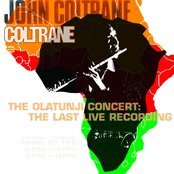
Tracklist 3 tracks
#
Title
Plays
1.
Introduction (Live in New York City, 23rd April 1967)
-
2.
Ogunde (Live in New York City, 23rd April 1967)
-
3.
My Favorite Things (Live in New York City, 23rd April 1967)
-
📖 About this album
YOUR PLAYS
21 scrobbles
TOTAL PLAYS
105093 scrobbles
LISTENERS
19974
The Olatunji Concert: The Last Live Recording is the Impulse! Records-released final live recording of saxophonist John Coltrane, recorded April 23, 1967, at the Olatunji Center of African Culture in New York and released on Compact Disc in 2001. The album consists of two songs—"Ogunde", which Coltrane also recorded for his final approved album, Expression, and an especially free-form "My Favorite Things", which Coltrane had performed live regularly since 1960. The recording was made for broadcast on Billy Taylor's local radio station, WLIB. The Olatunji Concert was not Coltrane's last show, but rather, his penultimate—he would play once more on Read more on Last.fm.
Read more
The Olatunji Concert: The Last Live Recording is the Impulse! Records-released final live recording of saxophonist John Coltrane, recorded April 23, 1967, at the Olatunji Center of African Culture in New York and released on Compact Disc in 2001. The album consists of two songs—"Ogunde", which Coltrane also recorded for his final approved album, Expression, and an especially free-form "My Favorite Things", which Coltrane had performed live regularly since 1960. The recording was made for broadcast on Billy Taylor's local radio station, WLIB. The Olatunji Concert was not Coltrane's last show, but rather, his penultimate—he would play once more on May 7, 1967, in Baltimore.
Coltrane had known Nigerian drummer Babatunde Olatunji since 1961, during which his band played opposite Olatunji's at the Village Gate, alternating with Art Blakey's group. Coltrane had studied Olatunji's recordings, and wrote the tune "Tunji," which appeared on the 1962 album Coltrane, in his honor. In 1966, Olatunji and his wife established the Olatunji Center of African Culture at 43 East 125th Street in Harlem, New York City, dedicated to "providing low cost classes in a wide range of cultural subjects to adults and children." Coltrane had provided financial support for the center while it was being built, and would continue to write checks to help cover its operating expenses. In July 1966, Coltrane "asked if he, Yusef Lateef, and Olatunji could form an organization to put on concerts, both at the Olatunji Center and at bigger venues." Olatunji also recalled that he offered to take Coltrane to Nigeria: "He said, 'When?' and I suggested the following year. He said 'God willing, I will.'"
On April 23, 1967, Coltrane and his group appeared in a benefit concert at and for the Olatunji Center. The concert poster advertised "John Coltrane & Quintet in Roots of Africa: his first appearance of 1967 in New York," and listed two shows: "4 pm - 6 pm" and "6 pm - 8 pm", with the invitation "Come join your host Babatunde. Ask Mr. Coltrane questions about his music and sound." (Only the first set was recorded.) The concert was m.c.ed by Billy Taylor, who recalled: "(Coltrane) called me and asked me to do that. Olatunji was right around the corner from the radio station (WLIB, where Taylor had a show). I knew Olatunji's work and on the station we played him a lot. He was really trying to do something to awaken the community to his view of the African heritage." The performance space was "a 30x100 foot loftlike room on the second floor, backdropped by colorful wall posters depicting an African village scene." The day of the concert, the crowd "spilled out into the hallway and down the stairs, onto the sidewalk and around the block." After the concert, "Coltrane asked for the receipts of all spent ($425) on the promotion and gave it back to the Center... He also divided the balance of what was left ($500) after paying each musician the union scale for each concert as was agreed upon with the Center."
Years after the concert, drummer Rashied Ali recalled: "with all the energy of 125th Street going on right outside the window... with incense burning and the place packed, he did something I had never seen him do before — he sat down on the bandstand. I still didn’t think he was sick, because when he put his horn to his mouth, there was no faltering; the fire was up full blast." About a month after the concert, Coltrane began to complain of intense abdominal pain; he died two months after that, in July.
Personnel
John Coltrane – soprano and tenor saxophone
Pharoah Sanders – tenor saxophone
Alice Coltrane – piano
Jimmy Garrison – double bass
Rashied Ali – drums
Algie DeWitt – Batá drum and possibly double bass
Jumma Santos – possibly percussion Read more on Last.fm. User-contributed text is available under the Creative Commons By-SA License; additional terms may apply.
free jazz
jazz
2001
spiritual jazz
avant-garde jazz
📝 About
-
🔗 Explore This Album
Rate Your Music
AllMusic
Last.fm
Discogs
MusicBrainz
Wikipedia
Google Reviews
YouTube
Bandcamp
SoundCloud
DeepSeek Chat
Links open in a new tab. Searches use the artist and album name from the current track. DeepSeek Chat opens the main chat – you can paste the album name there.